


Summer is in full throttle in Gloucestershire, with seemingly endless heatwaves. Working conditions have been very tough but we have soldiered on and have recently been working in and around Tetbury again.
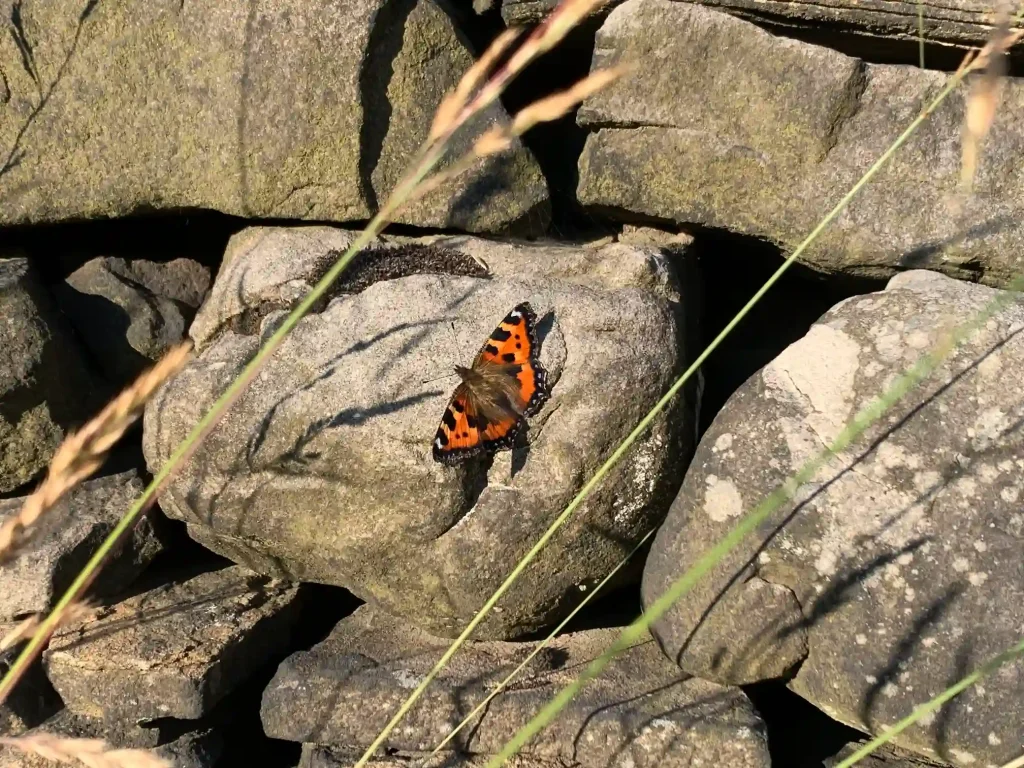
Many butterflies use dry stone walls as perfect resting places to open their wings and bask in the sun. We managed to capture a wonderful shot of a Small Tortoise Shell (Aglais urticae) doing exactly this!
The Small Tortoise Shell has an intimate relationship with dry stone walls, whilst they may use them for some sun-bathing in the warmer months, over the colder months they will use dry stone walls as their winter home for hibernation. Because they overwinter as adults, they live for about 10 months, having one of the longest lifespans of any butterfly.
One morning amongst a stack of stones we had laid out the day before, we found a slow worm (Anguis fragilis), also basking in the sun. A waller’s stack of stones creates a perfect habitat for a slow worm with all the nooks and crannies providing shelter from predators but also the possibility of some sun-bathing when given the chance. Slow worms are not snakes, they are legless lizards and like other reptiles, they spend the winter hibernating.
Unfortunately for this slow worm, the stack of stones needed to be used to rebuild the wall. We put it safely back at the base of an already built section of wall and it hastily wriggled away into the adjacent undergrowth.
On our visit to the Lancashire Dry Stone Walling Association (DSWA) branch, we came across many dry stone walls built from the local Millstone Grit. There was an abundance of foxgloves (Digitalis purpurea) growing from the sides of these walls. Foxgloves naturally thrive in Millstone Grit because the stone creates an acidic, free-draining environment with plenty of crevices where seeds can lodge and establish, making these walls an ideal habitat for the species.
To read more about the amazing biodiverse habitats of a dry stone wall, click here.